MAKING A DIFFERENCE
The Los Angeles River is special to Ed Reyes, who considers it an integral part of his childhood.
Reyes, 60, the executive director of River LA and a former Los Angeles City councilman, grew up about a half-mile from the river. He remembers playing chicken with the rail cars and using his Stingray bike to dodge the cars coming and going.
“I was about 9,” Reyes said. “Me and my friends would jump the fence. For us, we thought of it as a pool to swim in. We could fish. It became our Shangri-La.
“We couldn’t go to the park at that time because we’d get in fights with local gangs. But we could hear ourselves think down there by the river. We didn’t know there was spillage from the streets. The water was always moving so we couldn’t see it. It was seducing.”
Reyes, who grew up in Cypress Park near Dodger Stadium, said the experience stayed with him.
“The river became my goal as a council member,” said Reyes, who became a city councilman in 2001, representing District 1. “As the chairman of the Los Angeles River Ad Hoc Committee, I leveraged the planning power to create a focus on the river. In my mind, there was a huge void that connected the needs of our water system and related programs that should have served the dense and impoverished sections of our city.”
The city’s Ad Hoc Committee on the Los Angeles River, established in 2002, spearheaded efforts to launch the Revitalization Master Plan — aimed at enhancing existing communities by creating a safe environment with more open space, parks, trails, recreation, environmental restoration, riverfront living and commerce, new jobs, neighborhood identity, economic development, tourism and civic pride.
During that time, Reyes had high hopes for the river corridor.
“Piece by piece I wanted to change the urbanscape and infrastructure so that people could enjoy that waterway,” he said. “We created advocates and had tools to implement changes. We had portals for seniors. We built libraries in the district. We built high schools. It made me believe I can do this. I looked at the river as a spine to a regional network.
“The focus I had on the river was to create a sense of having the community at the table.”
When he became the executive director of River LA in January, Reyes continued his quest to improve the area around the river.
“It’s an amazing opportunity to create a toolbox that leverages public and private funds for the improvement of our urban setting and natural habits along the river corridor,” Reyes said.
River LA describes itself as a nonprofit on a mission to integrate design and infrastructure to bring people, water and nature together across all 51 miles of the L.A. River. The organization champions river-oriented policy and sustainable public spaces while creating innovative models for community benefit and participation.
When he took the reins at River LA, Reyes didn’t come empty-handed. What he brought to the table was two decades of experience working in the public sector and improving the quality of life for all Angelenos.
During his tenure on the City Council, Reyes chaired the council’s Planning and Land Use Management Committee where he expanded Los Angeles’ affordable housing stock. He led efforts to strengthen the city’s rent control ordinance making living more affordable for everyone and took strides to improve public transit for the city, spearheading efforts as chair of the Gold Line Authority to ensure that the $750 million Gold Line project was completed on time and on budget.
As chair of the Los Angeles River Ad Hoc Committee, Reyes secured more than $3 million to create a neighborhood-driven plan that included enhancing water quality, environmental protection, increasing open space and improving flood control.
Reyes said his goal as executive director was to create a water source, enhance scenarios and have natural habitats that become a healing source of communities of need.
“I wanted to engage recreation, engage ways to relieve pressure and new ways to use a natural habitat to capture inhabitants, lower the heat and smog footprints because of the use of fossil fuels,” Reyes said.
At one time, the Los Angeles River was neglected, but through the years, activists and the city recognized the river as offering huge potential for natural, community and economic resources which would present significant opportunities to revitalize the adjacent neighborhoods.
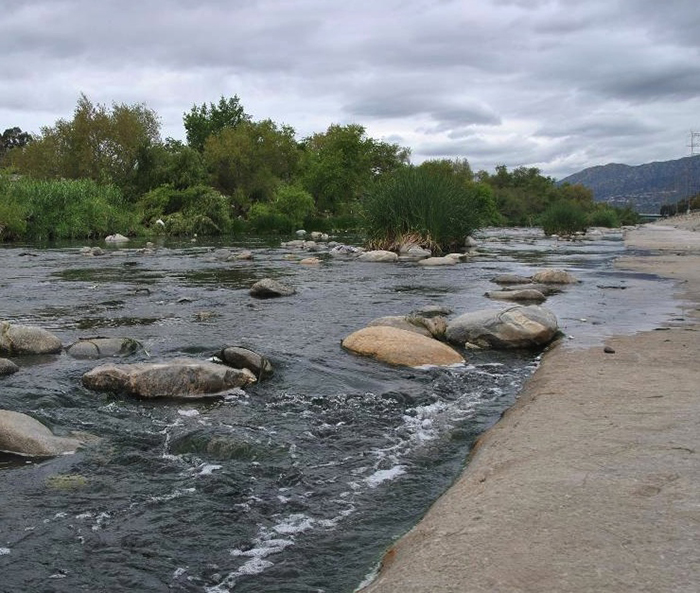
The river, which passes through 17 cities, is shaped like a comma. It begins in the western San Fernando Valley at the foothills of the Simi Hills and the Santa Monica and Santa Susana Mountains. It flows east, curving around Griffith Park and passing beneath the foothills of the San Gabriel Mountains before flowing south all the way to Long Beach and the Pacific Ocean.
Approximately 30% of the region’s major transportation stops are within a mile of the river, which makes it a key pedestrian, bicycle and equestrian transportation corridor. The 60 million gallons of water per day that flow out to the ocean during a typical dry season is enough to supply the city of Long Beach with its water needs.
About 715,000 people live within a half-mile of the river, making it one of the top 50 densest regions in the U.S.
Today, River LA’s vision is that the L.A. River is at the heart of a healthy, vibrant and resilient region.
“Why aren’t we storing water?” Reyes asked. “We should have storage capacity everywhere. Millions of gallons are lost every time we have rain.
“Why not be more creative and look at multiple purposes? Look at sources of water recycling. My granddaughter is 18 months old and I have a grandson who is 30 days old. When they turn 20 they may ask me, ‘What did you do?’ We have a chance right now to make a difference.”
“Making a Difference” is a weekly feature profiling organizations that are serving their communities. To propose a “Making a Difference” profile, send an email to .
By Darlene Donloe
Contributing Writer